Thursday, August 17, 2017

Standards-based Assessment: Final Reflection

Teacher Leadership Program Standard No. 11: Utilize formative and summative assessment in a standards-based environment
Background
In my previous work with professional learning communities, I have experienced the stress of formative assessment. The formal PLC model advocated by Rick DuFour includes a component on how teachers will know whether or not their students have learned. When I worked in California, my school district required that formative assessments, the “how,” must include measurable data that could be shared in our teams. The prominent form of this assessment came in multiple choice tests, and during the early years of my career, this is how I viewed formative assessment: it was another test to give students. All of my professional development on formative assessments focused on this attribute, and rarely did I view formative assessment as anything other than a multiple choice quiz.
The “how” component is critical, but the heavy emphasis on multiple choice blinded me to the potential and benefit of formative assessment. Upon starting a new teaching assignment in Washington state, I worked with colleagues and a school district that viewed formative assessment differently. It did not need to be formal, but it still needed to answer how I would know if the students had learned. Colleagues shared tools such as exit slips and questioning, many things that I had done for years but had never viewed as formative assessments. Entering my Standards-Based Assessment class, I had a small collection of tools and a general idea of what they were good for.
Learning and applied practice
Dylan Wiliam’s (2011) book Embedded Formative Assessment has been helpful in the process of learning about the role formative assessments play in my classroom. Wiliam’s definition of formative assessment emphasizes that it happens during learning, and this has had a tremendous impact on my thinking. Stopping instruction to give a test was counterproductive, especially if the results of that test were not analyzed until a later date. By the time my team had gone over the results, the class had moved on to another unit. We knew that was a problem at the time, but we plowed ahead anyway, following a school district mandate. Wiliam’s practical techniques open up the toolbox and allow the assessments to occur naturally and at appropriate times to allow the teacher to influence student learning.
Through the process of writing the assessment into action paper I discovered even more resources. The idea of writing workshops has me excited, as my students can choose the type of feedback and assessment they want through that process. I learned about Kaizena, an app that allows students to record questions and attach them to their papers and allows the teacher to record feedback. These are two of the elements I will incorporate into my practice this year.
Issues encountered
For my present teaching assignment, one dilemma for me will be the lack of a colleague to work directly with. I will be the only AP English Language teacher, so any discussion of how my students are meeting the learning expectations will have to be in the context of vertical or cross-curricular alignment. Fortunately, I have options in this area. By identifying the specific skills students are lacking, I can take those skills to other English teachers and solicit their input. Across the board, English-language arts skills generally are the same at the secondary level, so strategies that work in one class will transfer to another class with different content.
Supported by research
Wiliam’s (2011) book will be critical to my future practice. I appreciate his practical approach to formative assessment and his classroom applications are simply explained and varied in their use for elementary and secondary environments.
Shelby Scoffield’s (2016) article on Edutopia about writing workshops has strongly influenced my approach to giving feedback. This has been a bone of contention for me for years, the ingrained idea that I have to write comments on every paper, but the knowledge that students do not read them. Scoffield’s ideas about organizing writing workshops will help me provide my students feedback they can actually use.
Finally, the ideas about peer feedback I learned from Gielen, Tops, Dochy, Onghena, and Smeets (2010) will help me develop peer review sessions. Their findings showed that students improved when they were given writing prompts to use for peer feedback, such as “I paid attention to,” and “I found it difficult to” (p. 152). I can incorporate these sentence frames into feedback forms that allow me to clearly see how my students are doing.
Overall impact
I didn’t think formative assessment was an area of need for me, but after this course I appreciate the opportunity to grow in this area. I enter the school year with a lot of ideas that I can incorporate into my practice immediately.
References
Gielen, S., Tops, L., Dochy, F., Onghena, P., Smeets, S. (2010). A comparative study of peer and teacher feedback and of various peer feedback forms in a secondary school writing curriculum. British Educational Research Journal, 36:1, 143-162. doi: 10.1080/01411920902894070.
Scoffield, S. (2016). Creating a writers’ workshop in a secondary classroom. Edutopia. Retrieved from https://www.edutopia.org.

Wiliam, D. (2011). Embedded formative assessment. Bloomington, IN: Solution Tree.

Saturday, February 25, 2017

Significance and uncertainty as part of my theory of action

As part of my action research project, I created a graphic reconstruction of my theory of action. In the next step of determining research questions I first determined the significance of the different aspects and relationships of my theory of action. Those are visualized below, with an S showing a significant aspect or relationship.


The second walkthrough determined my confidence in the assumptions of my theory of action. Those are visualized below, with a U showing that I am relatively uncertain about the aspect or relationship.


Sunday, February 12, 2017

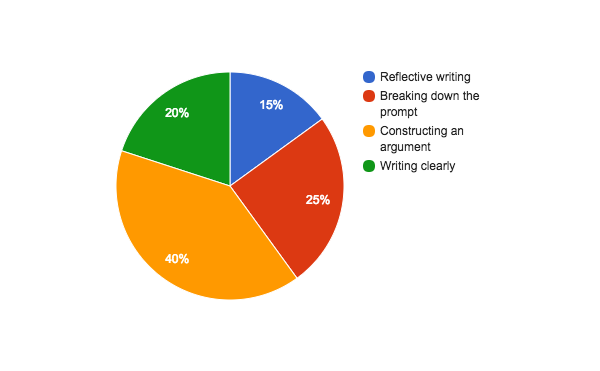
Priority pie for action research project

For my students to take time to revise their writing before submitting a final version, they will need direct instruction and feedback from me. I must teach them how to reflect on their writing. I must teach them to understand the prompt. I must teach them to recognize and construct a logical argument. I must teach them to write clearly.


The most critical element is being able to construct an argument. But because my issue is with revision, this presents a problem as constructing an argument is necessary to write the first draft. It’s a critical skill, and for revision it’s necessary because students will need to be able to identify a poorly constructed argument in order to correct it. I really should increase the importance of reflective writing, as it is most relevant to my achievement target. The two most important skills I want students to have through this process are constructing an argument and writing clearly. That’s worth two-thirds of their time.

Monday, December 5, 2016

Accomplished Teaching End of Course Reflection

Teacher Leadership Standard 4: Engage in analysis of teaching and collaborative practices

Over the course of this quarter I have learned much about the process of reflective practice as a teacher. I have seen how effective the process can be in collaborative sessions, and I have learned how to practice reflection individually and in progressively larger groups of people. What I missed was my own fault - I misread the date of our second face-to-face meeting in the University Place cohort, so I missed out on an opportunity to reflect with my colleagues about my videotaped lesson and about my students’ work. Through the process of developing and teaching the lesson, however, I learned much about my own practices and was able to apply techniques I learned through the reading of our text, Reflective Practice to Improve Schools: An Action Guide for Educators.

The initial reading assignments introduced me to a formalized reflection. The idea of reflection as a continuous practice appealed to me, partly because I have been reflecting in various forms throughout my career. The book’s authors created a Theory of Action for Reflective Practice, one that starts with a pause, continues with openness, and includes inquiry, thinking, learning, and action. The continuum ends with enhanced student learning (York-Barr, Sommers, Ghere, and Montie, p. 9). I have practiced all of these at points, but the coalescing of these elements into one theory has allowed me to focus my reflection on that final goal, enhanced student learning. Only by taking time and being open to change can I begin asking questions, thinking about the answers, learning new material, and applying it to my practice.

This process helped as I approached the videotaped lesson [lesson plan]. My initial conversations with my colleague Alex at our first face-to-face class led me to think I had a promising grasp on my lesson. His questions, however, led me to stay focused on my objectives and not try to fit too much into my instruction. After the lesson, I remembered why watching yourself teach is awkward, but I had to keep an open mind about what I initially thought was a decent lesson. The biggest question I asked myself was whether my students had actually learned anything. Our discussion was centered on a few students; not everybody had an opportunity to contribute, and upon reflection, I was able to come up with some collaborative strategies, such as think-pair-share, that I have since applied to other classroom discussions. [Synthesizing Elements of Accomplished Teaching]

While I missed out on an opportunity to reflect with my colleagues, I would like to have more such chances to do so within the scope of this program. I found the interaction enlightening and valuable. More opportunities for reflection would further help me meet the course objective to practice the fundamentals of reflection.

References

York-Barr, J., Sommers, W. A., Ghere, G. S., and Montie, J. (2006). Reflective Practice to Improve Schools: An Action Guide for Educators. Thousand Oaks, Calif.: Corwin Press.

Sunday, December 4, 2016

Teaching with Technology: Reflecting on my Module 5 triggering question

ISTE Standard 5: Engage in Professional Growth and Leadership
Teachers continuously improve their professional practice, model lifelong learning and exhibit leadership in their school and professional communities by promoting and demonstrating the effective use of digital tools and resources.
a. Participate in local and global learning communities to explore creative applications of technology to improve student learning.
b. Exhibit leadership by demonstrating a vision of technology infusion, participating in shared decision making and community building, and developing the leadership and technology skills of others.
c. Evaluate and reflect on current research and professional practice on a regular basis to make effective use of existing and emerging digital tools and resources in support of student learning.
d. Contribute to the effectiveness, vitality and self-renewal of the teaching profession and of their school and community.

How can I best promote technology to my colleagues who might be techno-phobic?

I ask myself why I would want teachers to use more technology in their classrooms. We’re a busy bunch, after all, and one more item on the plate isn’t necessarily going to make us better teachers. I enjoy using technology, and I like to share that enjoyment with my students. If another teacher doesn’t enjoy using technology, then that person isn’t going to be an effective user in the classroom.

Yet many of my techno-phobic colleagues use Facebook. They interact socially with friends, family, and colleagues. They share how their day went, pass along photos of great-looking meals, and even share recipe videos of how those meals were put together. Why not do the same for teaching? Carpenter writes that “social media facilitates participation, challenges hierarchies, and helps build professional networks that support teacher collaboration and autonomy” (2016). He advocates the use of social media as a teacher-directed professional development tool. Sites such as Twitter, Pinterest, and Edmodo offer opportunities for teachers to do for their professional growth what they already do for their personal growth. What’s encouraging is that many teachers are already taking advantage of this, and on their own time. “In an era of intense demands on educators, ... teachers are willing to give up their personal time to participate in this unremunerated professional learning” (Carpenter, 2016).

Using technology to advance one’s professional development makes sense, but technology itself won’t make us better teachers. Good learning comes from good teaching, and the medium used doesn’t necessarily matter. De Bruyckere, Kirschner, and Hulshof dispel the myth that technology is causing a revolution in the classroom in their article “Technology in Education: What Teachers Should Know” (2016). They propose that “the medium seldom influences teaching, learning, and education, nor is it likely that one single medium will ever be the best one for all students” (De Bruyckere, Kirschner, and Hulshof, 2016). Having a SmartBoard in your classroom won’t make you a better teacher if all you do is use it as a projector screen. But employing it to engage students and interact with material can have pedagogical benefits. “Effective instructional methods can improve learning outcomes across different media, whereas using hand-held instructional media may increase students’ willingness to continue to engage in learning” (De Bruyckere, Kirschner, and Hulshof, 2016).

When used appropriately, technology has tremendous benefits for students. An East Los Angeles teacher, Enrique Legaspi, uses Twitter to engage his students in his middle school social studies class. The same type of work students would do in a classroom discussion review of World War I, for example, can be done through Twitter - by all students, not just a few. “A lot of them, what it did help them with was finding their voice, because I do have many students that do not participate in my class discussions or share what’s on their mind,” Legaspi told CNN’s Dan Simon (2011). He uses Twitter to increase participation, but he can also differentiate his instruction based on that participation. That’s the pedagogy at work.

Results like Legaspi’s should be shared, as should the benefits of using social media to improve professional development. As more positive examples of the uses of technology become apparent, my techno-phobic colleagues will come around. As long as they are interested in the future of their profession, they’ll find advantages in adapting technology for their own purposes.

References

De Bruyckere, P., Kirschner, P. A., and Hulshof, C. D. (2016, Spring). Technology in Education: What Teachers Should Know. American Educator, Spring 2016. Retrieved on November 29th from http://www.aft.org/ae/spring2016/debruyckere-kirschner-and-hulshof


Simon, D. (Reporter). (June 9, 2011). Twitter has place in classroom. Retrieved on December 4th from https://www.youtube.com/watch?v=2w9CnaeaiAE