Prior to this program, I had little time to look into research concerning my teaching practice. The practice of teaching occupied my mind constantly, but other than the occasional professional development, I rarely took time to consider the profession of teaching and how to improve it. Not that I had ignored research or had no desire to look into research; I just never set that as a priority in my career. While taking Action Research and Applying Research, however, I saw the potential for becoming a better teacher through educational research, both through practicing such research and reviewing it.
Through the Action Research class I devised a plan to improve how I use revision in my AP English Language & Composition class. I developed a workshop model that used peer review to improve student writing. I was able to measure both how students improved developed action plans to improve their writing and how they used those plans to improve their writing. The end results were promising, and I have used that model regularly since I conducted the study.
Through that research I identified multiple articles that apply to my practice. One, for example, considered the reliability and validity of peer review specifically in AP English classes. The study found that “carefully designed peer review tasks can provide students with helpful feedback” (Schunn et al., 2016, p. 22). Through that research I have expanded my own use of peer review in my classroom, and I intend to continue looking into and conducting research on peer review as a means of improving my students’ writing.
In the Applying Research class I saw the potential for identifying good research and critiquing said research. The class helped me identify the different components of research and examine the relationship between those components.
Again, the assignments in that class aligned with my own classroom practice; the secondary research article I analyzed dealt with the need to identify propaganda and promote media literacy, while the primary research cited in that article studied strategies for teaching how to identify fake news and propaganda. While I initially found the secondary article by Hobbs (2017) informative and valuable, I later analyzed that she had overgeneralized the results found in the primary research by Kahne & Bowyer (2017). The overgeneralization did not significantly affect Hobbs’ (2017) argument, but it did cause me to pause and reflect about the importance of examining the primary research.
Upon reflection, I wish I would have had the Applying Research class before Action Research. After taking Applying Research I find myself more familiar with the terms used in research paper. I better understand what independent and dependent variables are, I comprehend how research is assembled and carried out, and I know the statistical tools being used and their purpose. I had none of that knowledge when I conducted the literature review for my Action Research project, and that information may have affected my use of that literature to guide my own research. For example, a study by Yoder (1993) examined how peer review could be used to help journalism students in college. Had I known about external validity, I might have realized that the results Yoder (1993) found were unlikely to be able to be generalized to my particular population of high school English students. Besides, Yoder (1993) had a small sample size that may not have been representative of the larger population.
I plan to continue to consume and examine educational research throughout my career. One challenge I foresee is access to primary research; through the Seattle Pacific teacher leadership program I have access to the library’s databases, but when that access has ended, I will have to find other means to access primary research. I am not worried about secondary research; the internet is full of that, and I feel confident in my ability to sort the wheat from the chaff. For example, a recent article by Ford and Lee (2018) in the English Journal offered a case study on how to improve high school vocabulary instruction. The authors cited 11 sources, most of which were other secondary or curricular sources. The one piece of primary research came from a study of fifth graders, focused on learning in context, and was 34 years old (Jenkins et al., 1984). I found several ideas within the article, but without more solid research proving their efficacy, I’m reluctant to change my entire vocabulary program based on one piece of secondary research.
References
Ford, R. D., & Lee, M. E. (2018). Fostering a new approach to vocabulary, 30 years in the making. English Journal, 107(4), 39-44.
Hobbs, R. (2017). Teaching and learning in a post-truth world: It’s time for schools to upgrade and reinvest in media literacy lessons. Educational Leadership, 75(3), 26-31.
Jenkins, J. R., Stein, M. L., & Wysocki, K. (1984). Learning vocabulary through reading. American Educational Research Journal, 21(4), 767-787.
Kahne, J., & Bowyer, B. (2017). Education for democracy in a partisan age: Confronting the challenges of motivated reasoning and misinformation. American Educational Research Journal, 54(1), 3-34.
Schunn, C., Godley, A., & DeMartino, S. (2016). The reliability and validity of peer review of writing in high school AP English classes. Journal of Adolescent & Adult Literacy, 60(1), 13-23.
Yoder, S. L. (1993). Teaching writing revision: Attitudes and Copy Changes. Journalism Educator, 47(4), 41-47.
Showing posts with label revision. Show all posts
Showing posts with label revision. Show all posts
Sunday, April 1, 2018

Saturday, February 25, 2017
Significance and uncertainty as part of my theory of action
As part of my action research project, I created a graphic reconstruction of my theory of action. In the next step of determining research questions I first determined the significance of the different aspects and relationships of my theory of action. Those are visualized below, with an S showing a significant aspect or relationship.

The second walkthrough determined my confidence in the assumptions of my theory of action. Those are visualized below, with a U showing that I am relatively uncertain about the aspect or relationship.

The second walkthrough determined my confidence in the assumptions of my theory of action. Those are visualized below, with a U showing that I am relatively uncertain about the aspect or relationship.
Thursday, February 23, 2017
Sunday, February 12, 2017
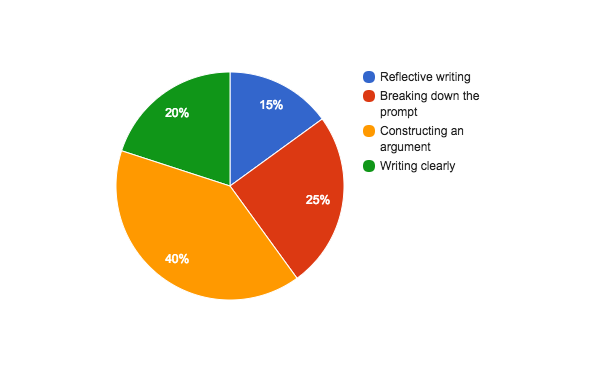
Priority pie for action research project
For my students to take time to revise their writing before submitting a final version, they will need direct instruction and feedback from me. I must teach them how to reflect on their writing. I must teach them to understand the prompt. I must teach them to recognize and construct a logical argument. I must teach them to write clearly.
The most critical element is being able to construct an argument. But because my issue is with revision, this presents a problem as constructing an argument is necessary to write the first draft. It’s a critical skill, and for revision it’s necessary because students will need to be able to identify a poorly constructed argument in order to correct it. I really should increase the importance of reflective writing, as it is most relevant to my achievement target. The two most important skills I want students to have through this process are constructing an argument and writing clearly. That’s worth two-thirds of their time.
Subscribe to:
Posts (Atom)