My Action Research class consisted of an in-depth project about providing feedback to students regarding their writing. Providing feedback has been a particular interest to me: I teach five sections of Advanced Placement English Language & Composition, and with 150 student writers wanting significant feedback on a regular basis, I have sought a way to do that in a timely fashion that leaves me a personal life. Think about it: when 150 students write a 4-page paper, that’s 600 pages to read and give feedback on. And that doesn’t count the two-page timed writes that my students write on a regular basis, nor the journal entries they write weekly. How do I handle the workload?
Through my action research project, I learned about the value of peer feedback through writing workshops. A study by Early and Saidy (2014) revealed that students used written feedback to encourage their peers to add textual evidence, improve aesthetic elements, and develop voice. I instituted a three-day writers workshop in which students shared their rough drafts, provided specific feedback, and then used that feedback to revise their papers. The students did produce better quality papers after the workshop, even though it still took me a significant amount of time to grade the papers afterward. I have since modified my use of writing workshops; a three-day workshop takes more time than I can commit, so I pared the workshop to one day this year. The workshops focused more on different "stations" that students rotated through, centers focused not only on peer review but on finding dead words such as really and very, reading their text aloud, finding specific grammatical problems such as run-on sentences, and a station where I read their paper and give them immediate feedback. I had mixed results with this form of workshop; my students generally turn in polished papers, but I felt much of the time was wasted as students did not have as strong a structure to perform the peer review. I am strongly considering going back to my three-day model in an attempt to give them more detailed and useful feedback, and to allow students to provide that feedback. This would also allow me to incorporate more the cooperative learning that Dean, Hubbell, Pitler, and Stone (2012) advocate for.
The significance of proper feedback cannot be overstated. Wiliam (2011) cites a study that shows that students who received constructive feedback learned twice as fast as a control group. Marzano (2007) says goal setting and feedback are more effective when done together. Dean et al. (2012) say teachers can create a classroom focused on learning by providing feedback that is “corrective, timely, and focused on criteria” (p. 11). Pitler and Stone (2012) encourage teachers to “engage students in the feedback process” (p. 24).
I recognize the importance of providing quality feedback; that isn’t the problem. Finding the time to provide that feedback in a writing class is my greatest challenge, one I will continue to undertake as my career moves forward.
References
Dean, C. B., Hubbell, E. R., Pitler, H., and Stone, B. (2012). Classroom instruction that works: Research-based strategies for increasing student achievement. Alexandria, VA: ASCD.
Early, J. S., & Saidy, C. (2014). Uncovering substance: Teaching revision in high school classrooms. Journal of Adolescent & Adult Literacy, 58(3), 209-218.
Marzano, R. J. (2007). The art and science of teaching: A comprehensive framework for effective instruction. Alexandria, VA: ASCD.
Pitler, H., and Stone, B. (2012). A handbook for classroom instruction that works. Alexandria, VA: ASCD.
Wiliam, D. (2011). Embedded formative assessment. Bloomington, IN: Solution Tree.
Showing posts with label action research. Show all posts
Showing posts with label action research. Show all posts
Thursday, May 3, 2018

Sunday, April 1, 2018
Reflection on Teacher Leadership Standard 3: Educational Research
Prior to this program, I had little time to look into research concerning my teaching practice. The practice of teaching occupied my mind constantly, but other than the occasional professional development, I rarely took time to consider the profession of teaching and how to improve it. Not that I had ignored research or had no desire to look into research; I just never set that as a priority in my career. While taking Action Research and Applying Research, however, I saw the potential for becoming a better teacher through educational research, both through practicing such research and reviewing it.
Through the Action Research class I devised a plan to improve how I use revision in my AP English Language & Composition class. I developed a workshop model that used peer review to improve student writing. I was able to measure both how students improved developed action plans to improve their writing and how they used those plans to improve their writing. The end results were promising, and I have used that model regularly since I conducted the study.
Through that research I identified multiple articles that apply to my practice. One, for example, considered the reliability and validity of peer review specifically in AP English classes. The study found that “carefully designed peer review tasks can provide students with helpful feedback” (Schunn et al., 2016, p. 22). Through that research I have expanded my own use of peer review in my classroom, and I intend to continue looking into and conducting research on peer review as a means of improving my students’ writing.
In the Applying Research class I saw the potential for identifying good research and critiquing said research. The class helped me identify the different components of research and examine the relationship between those components.
Again, the assignments in that class aligned with my own classroom practice; the secondary research article I analyzed dealt with the need to identify propaganda and promote media literacy, while the primary research cited in that article studied strategies for teaching how to identify fake news and propaganda. While I initially found the secondary article by Hobbs (2017) informative and valuable, I later analyzed that she had overgeneralized the results found in the primary research by Kahne & Bowyer (2017). The overgeneralization did not significantly affect Hobbs’ (2017) argument, but it did cause me to pause and reflect about the importance of examining the primary research.
Upon reflection, I wish I would have had the Applying Research class before Action Research. After taking Applying Research I find myself more familiar with the terms used in research paper. I better understand what independent and dependent variables are, I comprehend how research is assembled and carried out, and I know the statistical tools being used and their purpose. I had none of that knowledge when I conducted the literature review for my Action Research project, and that information may have affected my use of that literature to guide my own research. For example, a study by Yoder (1993) examined how peer review could be used to help journalism students in college. Had I known about external validity, I might have realized that the results Yoder (1993) found were unlikely to be able to be generalized to my particular population of high school English students. Besides, Yoder (1993) had a small sample size that may not have been representative of the larger population.
I plan to continue to consume and examine educational research throughout my career. One challenge I foresee is access to primary research; through the Seattle Pacific teacher leadership program I have access to the library’s databases, but when that access has ended, I will have to find other means to access primary research. I am not worried about secondary research; the internet is full of that, and I feel confident in my ability to sort the wheat from the chaff. For example, a recent article by Ford and Lee (2018) in the English Journal offered a case study on how to improve high school vocabulary instruction. The authors cited 11 sources, most of which were other secondary or curricular sources. The one piece of primary research came from a study of fifth graders, focused on learning in context, and was 34 years old (Jenkins et al., 1984). I found several ideas within the article, but without more solid research proving their efficacy, I’m reluctant to change my entire vocabulary program based on one piece of secondary research.
References
Ford, R. D., & Lee, M. E. (2018). Fostering a new approach to vocabulary, 30 years in the making. English Journal, 107(4), 39-44.
Hobbs, R. (2017). Teaching and learning in a post-truth world: It’s time for schools to upgrade and reinvest in media literacy lessons. Educational Leadership, 75(3), 26-31.
Jenkins, J. R., Stein, M. L., & Wysocki, K. (1984). Learning vocabulary through reading. American Educational Research Journal, 21(4), 767-787.
Kahne, J., & Bowyer, B. (2017). Education for democracy in a partisan age: Confronting the challenges of motivated reasoning and misinformation. American Educational Research Journal, 54(1), 3-34.
Schunn, C., Godley, A., & DeMartino, S. (2016). The reliability and validity of peer review of writing in high school AP English classes. Journal of Adolescent & Adult Literacy, 60(1), 13-23.
Yoder, S. L. (1993). Teaching writing revision: Attitudes and Copy Changes. Journalism Educator, 47(4), 41-47.
Through the Action Research class I devised a plan to improve how I use revision in my AP English Language & Composition class. I developed a workshop model that used peer review to improve student writing. I was able to measure both how students improved developed action plans to improve their writing and how they used those plans to improve their writing. The end results were promising, and I have used that model regularly since I conducted the study.
Through that research I identified multiple articles that apply to my practice. One, for example, considered the reliability and validity of peer review specifically in AP English classes. The study found that “carefully designed peer review tasks can provide students with helpful feedback” (Schunn et al., 2016, p. 22). Through that research I have expanded my own use of peer review in my classroom, and I intend to continue looking into and conducting research on peer review as a means of improving my students’ writing.
In the Applying Research class I saw the potential for identifying good research and critiquing said research. The class helped me identify the different components of research and examine the relationship between those components.
Again, the assignments in that class aligned with my own classroom practice; the secondary research article I analyzed dealt with the need to identify propaganda and promote media literacy, while the primary research cited in that article studied strategies for teaching how to identify fake news and propaganda. While I initially found the secondary article by Hobbs (2017) informative and valuable, I later analyzed that she had overgeneralized the results found in the primary research by Kahne & Bowyer (2017). The overgeneralization did not significantly affect Hobbs’ (2017) argument, but it did cause me to pause and reflect about the importance of examining the primary research.
Upon reflection, I wish I would have had the Applying Research class before Action Research. After taking Applying Research I find myself more familiar with the terms used in research paper. I better understand what independent and dependent variables are, I comprehend how research is assembled and carried out, and I know the statistical tools being used and their purpose. I had none of that knowledge when I conducted the literature review for my Action Research project, and that information may have affected my use of that literature to guide my own research. For example, a study by Yoder (1993) examined how peer review could be used to help journalism students in college. Had I known about external validity, I might have realized that the results Yoder (1993) found were unlikely to be able to be generalized to my particular population of high school English students. Besides, Yoder (1993) had a small sample size that may not have been representative of the larger population.
I plan to continue to consume and examine educational research throughout my career. One challenge I foresee is access to primary research; through the Seattle Pacific teacher leadership program I have access to the library’s databases, but when that access has ended, I will have to find other means to access primary research. I am not worried about secondary research; the internet is full of that, and I feel confident in my ability to sort the wheat from the chaff. For example, a recent article by Ford and Lee (2018) in the English Journal offered a case study on how to improve high school vocabulary instruction. The authors cited 11 sources, most of which were other secondary or curricular sources. The one piece of primary research came from a study of fifth graders, focused on learning in context, and was 34 years old (Jenkins et al., 1984). I found several ideas within the article, but without more solid research proving their efficacy, I’m reluctant to change my entire vocabulary program based on one piece of secondary research.
References
Ford, R. D., & Lee, M. E. (2018). Fostering a new approach to vocabulary, 30 years in the making. English Journal, 107(4), 39-44.
Hobbs, R. (2017). Teaching and learning in a post-truth world: It’s time for schools to upgrade and reinvest in media literacy lessons. Educational Leadership, 75(3), 26-31.
Jenkins, J. R., Stein, M. L., & Wysocki, K. (1984). Learning vocabulary through reading. American Educational Research Journal, 21(4), 767-787.
Kahne, J., & Bowyer, B. (2017). Education for democracy in a partisan age: Confronting the challenges of motivated reasoning and misinformation. American Educational Research Journal, 54(1), 3-34.
Schunn, C., Godley, A., & DeMartino, S. (2016). The reliability and validity of peer review of writing in high school AP English classes. Journal of Adolescent & Adult Literacy, 60(1), 13-23.
Yoder, S. L. (1993). Teaching writing revision: Attitudes and Copy Changes. Journalism Educator, 47(4), 41-47.
Saturday, February 25, 2017
Significance and uncertainty as part of my theory of action
As part of my action research project, I created a graphic reconstruction of my theory of action. In the next step of determining research questions I first determined the significance of the different aspects and relationships of my theory of action. Those are visualized below, with an S showing a significant aspect or relationship.

The second walkthrough determined my confidence in the assumptions of my theory of action. Those are visualized below, with a U showing that I am relatively uncertain about the aspect or relationship.

The second walkthrough determined my confidence in the assumptions of my theory of action. Those are visualized below, with a U showing that I am relatively uncertain about the aspect or relationship.
Thursday, February 23, 2017
Sunday, February 12, 2017
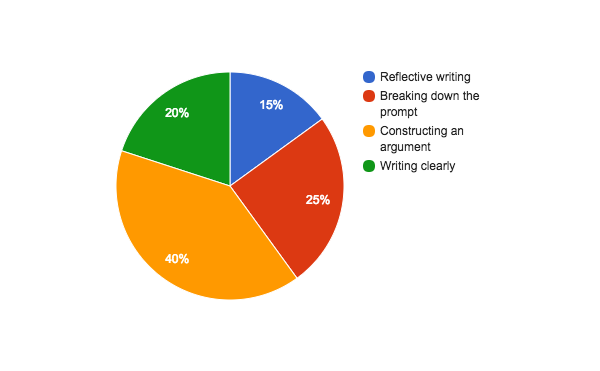
Priority pie for action research project
For my students to take time to revise their writing before submitting a final version, they will need direct instruction and feedback from me. I must teach them how to reflect on their writing. I must teach them to understand the prompt. I must teach them to recognize and construct a logical argument. I must teach them to write clearly.
The most critical element is being able to construct an argument. But because my issue is with revision, this presents a problem as constructing an argument is necessary to write the first draft. It’s a critical skill, and for revision it’s necessary because students will need to be able to identify a poorly constructed argument in order to correct it. I really should increase the importance of reflective writing, as it is most relevant to my achievement target. The two most important skills I want students to have through this process are constructing an argument and writing clearly. That’s worth two-thirds of their time.
Subscribe to:
Posts (Atom)